Forget forgiveness. Question everything. Reclaim your Will.
There is another side to occult practice: one that does not concern itself with love and light, convenient spiritual platitudes or the expectation that every wrong must be met with forgiveness.
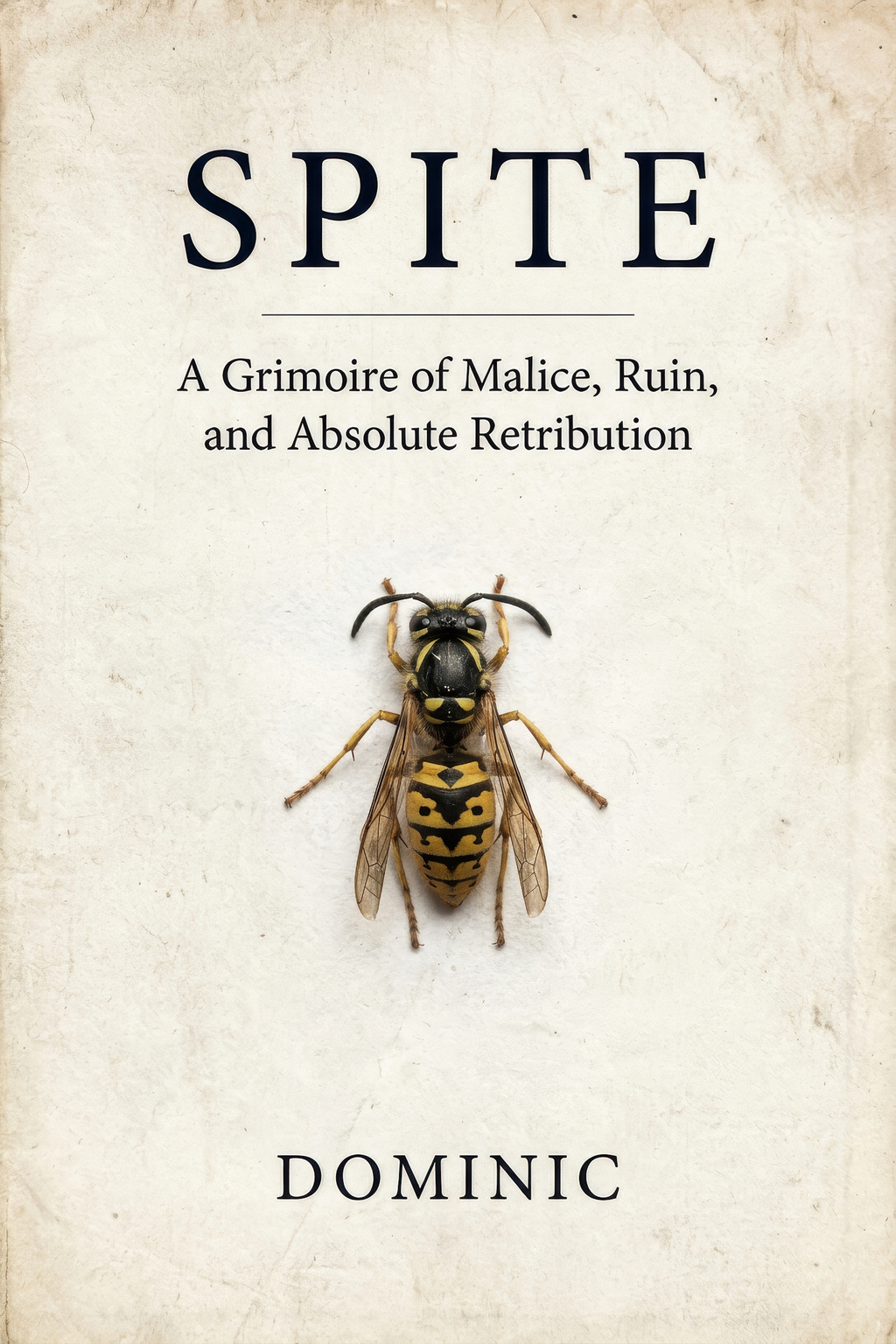
Spite: A Grimoire of Malice, Ruin, and Absolute Retribution, by Dominic, enters this darker territory.
An uncompromising exploration of Satanic magick, black magic, hexcraft and baneful occult practices, Spiteexamines the philosophy of magical retribution, the use of personal Will and the darker aspects of Left-Hand Path spirituality.
This is a grimoire for readers interested in the forbidden, the unconventional and the practices that sit outside the comfortable boundaries of mainstream modern spirituality.
The subject of Satanic spells and dark occult practices is often surrounded by sensationalism, misunderstanding and romanticised portrayals. Spite approaches its subject through the language and philosophy of malefic magick, examining the symbolism, methods and intentions associated with destructive magical workings.
The book explores a range of traditional and contemporary occult themes, including:
Hexcraft and curse magic: The philosophy and construction of workings associated with magical retribution.
Destructive sigils: The use of symbolic forms and focused intention in baneful magical practice.
Sour jars and poppets: Sympathetic magical techniques and their place within malefic witchcraft.
Taglocks and magical links: The use of personal connections and symbolic materials in targeted workings.
Graveyard and crossroads magic: The significance of graveyard dirt, crossroads dust and other traditional occult materials.
Binding and long-term hexes: An examination of workings intended to restrict, disrupt or influence.
Demonic invocation: Exploring darker spiritual practices and the symbolism of working with demonic entities.
Egregores and mirror magic: The creation and use of occult constructs, reflective symbolism and focused magical intention.
These subjects are explored within a broader discussion of the Left-Hand Path and the relationship between anger, intention, power and personal sovereignty.
Modern spirituality frequently encourages forgiveness, positivity and emotional detachment. But Spite challenges the assumption that every practitioner must follow the same spiritual expectations.
Dominic explores the idea that anger need not automatically be treated as weakness. It can be examined, understood and channelled into a deliberate expression of personal Will.
The book rejects the expectation that people must always remain passive in the face of betrayal, manipulation or injustice. Instead, it considers the darker philosophical territory of retribution, self-determination and the refusal to surrender one's sense of authority.
This is not a conventional introduction to white witchcraft or gentle manifestation practices. It is an exploration of the more confrontational aspects of occult philosophy.
Destructive magical practices raise questions that cannot simply be ignored. What happens after a working has been performed? What about unwanted consequences, lingering attachments or the need to restore personal boundaries?
Spite does not treat destruction as the only consideration. Its later sections examine magical aftermath, cleansing, sealing and the importance of understanding the consequences associated with occult practice.
Ultimately, the book returns to a central idea: personal sovereignty.
Revenge can become an obsession. Hatred can consume the very person who carries it. The ability to reclaim one's life, establish boundaries and refuse to remain defined by past grievances is therefore an essential part of the book's wider philosophy.
Spite may appeal to readers interested in:
Satanic magick and Satanic spellcraft.
Black magic and baneful witchcraft.
Hexes, curses and sympathetic magic.
Left-Hand Path philosophy.
Demonic invocation and darker occult practices.
Traditional and contemporary grimoire literature.
Egregores, sigils and magical symbolism.
Occult philosophy, personal Will and sovereignty.
Whether you are an experienced practitioner, an independent student of the occult or simply interested in the darker corners of magical literature, this book offers a deliberately provocative perspective.
Spite: A Grimoire of Malice, Ruin, and Absolute Retribution is an exploration of malefic magick, Satanic occult themes, hexcraft and the philosophy of personal sovereignty.
It questions conventional spiritual expectations and examines what it means to take ownership of one's Will, one's anger and one's choices.
Your anger is yours. Your Will is yours. Your sovereignty is yours.
The question is whether you are prepared to own it.
[Discover SPITE and obtain your copy today.]
There is no soulmate. There is appetite, attention, and a body that can be trained.
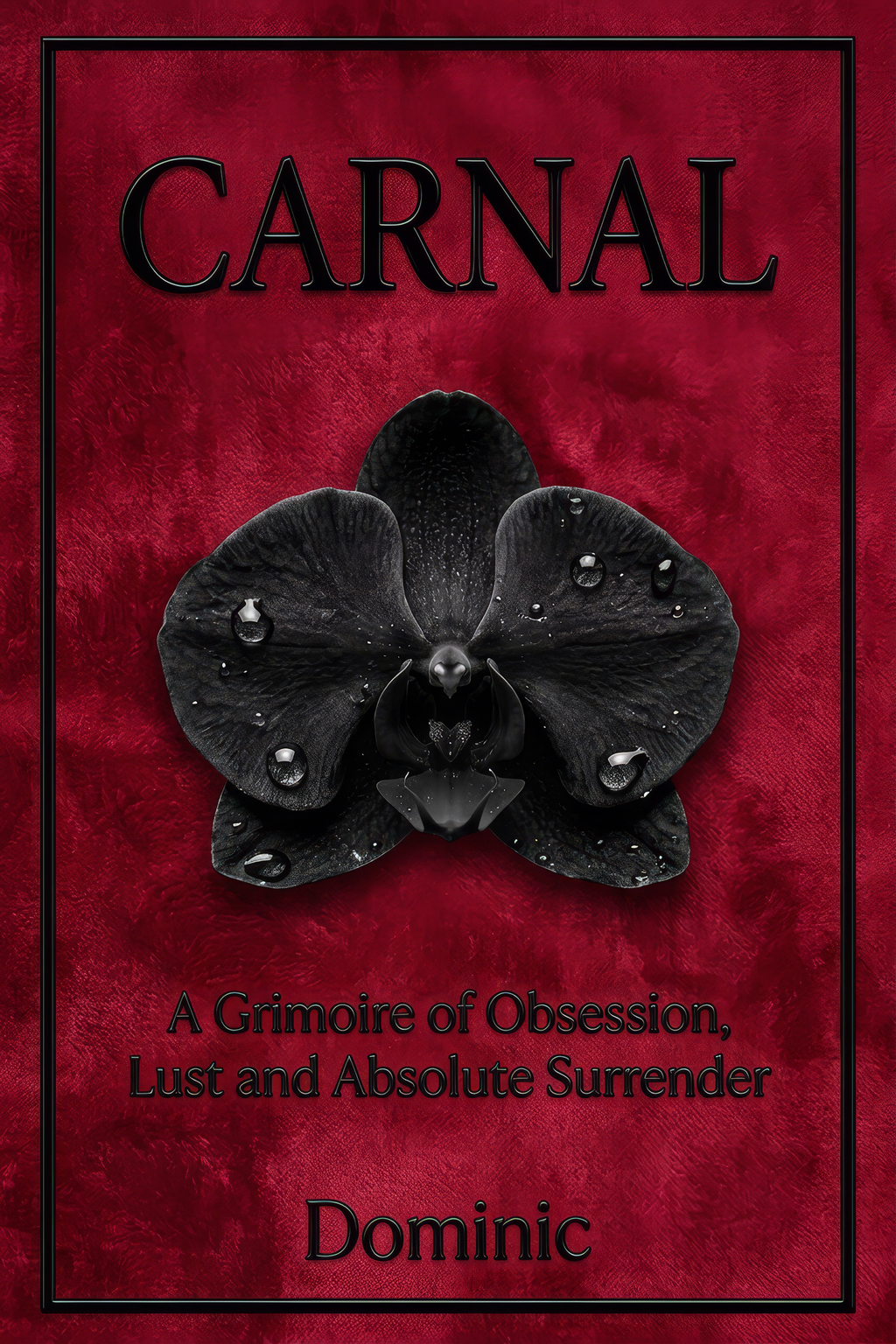
Carnal: A Grimoire of Obsession, Lust, and Absolute Surrender is Dominic’s manual for men and women who have finished with romantic propaganda and want the machinery underneath it. It is not a book of safe words, spiritual growth, or cosmic matchmaking. It is a cold, exact work of lust magick: equal in capacity, indifferent to which sex holds the leash, and written for adults who can tell a persona from a warrant.
If you have searched for sex magick that does not apologise, for obsession that is treated as craft rather than fate, or for a black-magic voice that will not call predation “healing,” this is the book.
What Carnal Actually Is
Carnal runs in five parts and twenty-five chapters. It begins by stripping the soulmate myth—the velvet noose sold by poets, priests, and film studios—and ends with the operator installed, if the work has been narrow and repeated, as the figure someone else’s private arousal uses when the room is empty.
Between those poles the book builds a sequence:
The voice is Queen’s English. It is filthy where accuracy requires filth, and plain where grandeur would only miss. Heat belongs in the rite. Instruction stays cold.
Lust Magick Without the Romantic Lie
Most books on erotic magick still smuggle destiny back in through the side door. They promise a counterpart, a twin flame, a love that transcends the meat. Carnal treats that story as propaganda. Pair-bonding is real and provisional. Oxytocin is not metaphysics. Novelty decays. The person who once felt like salvation becomes furniture, and the magician files that under data, not tragedy.
Equality here is not kindness. It is the refusal to grant either sex a moral exemption. A woman can hunt as ruthlessly as a man. A man can be reduced to a devoted instrument as thoroughly as any woman. The architecture of desire does not consult your politics. It consults whether you will stop lying about what you want when the lights are off.
That is the book’s centre of gravity: obsession as a technology, not a wound you wait for the universe to close.
Who the Book Is For
Read Carnal if you already know the polite catechism and find it useless in bed.
It is for the practitioner who wants a sentence short enough to survive the edge of orgasm. For the reader who is tired of “be yourself and trust the timing.” For men who were trained to apologise for hunger, and for women who were trained to withhold it until it looked like a prize. Both trainings produce liars. The grimoire is not interested in the lie.
It is not for minors. It is not a medical manual, a legal brief, or a permission slip. The rituals are literary inventions in the form of a working book. Criminal acts remain criminal. Fiction does not licence them. Dominic says this once, in the disclaimer, and then does not interrupt the rites to repeat it.
How the Craft Is Organised
Part I demolishes the soulmate and sets the gaze, the bypass of the waking mind, the materials, and the short ethic: know what you are doing, and bear the cost.
Part II is mechanics. Sigils wire a nervous system for cock and cunt. The honey jar sweetens a target for the kill. Sex magick treats climax as current, not as a souvenir. Fuels are ranked by burn rate. Glamour makes the visible surface agree with the private spend.
Part III is domination. Plant the intrusive thought. Invade the sleep cycle. Collar for fidelity. Spoil rivals with impotence and frigidity hexes aimed at everyone who is not you. Sound the siren when you want the ruined thing returned to your hand.
Part IV escalates: entities, pacts of the flesh, an egregore for stamina, the mirror that makes them addicted to your reflection, the bedroom consecrated as an altar.
Part V is the part most grimoires skip, because it is less flattering. Post-nut clarity. How to break the leash. How to banish a lingering obsession from your own mouth. How to feed on devotion without becoming the thing that needs it. How to become, in one precise and limited sense, the living god of their wet dreams—and how not to wave that blade at every room.
Why the Prose Is Cold
Operators miss when they write in grandeur. Carnal refuses the miss. A black candle and a speech do not outperform a precise sentence held through an actual climax. Five commands stacked into one orgasm are not a working. They are splatter. Confession to the target spends the residue on their reaction. A jar that rots is failure of containment, not an extra spirit.
The coldness is a device. It keeps the reader from mistaking costume for current. If the meters do not move—sleep, irritability, unprompted contact, a stall with a rival, a return that was not chased—the book tells you to narrow the sentence and fire again. Invisible success is not success. It is self-hypnosis with expensive candles.
A Book You Can Put Down
The epilogue is as severe as the prologue. A grimoire left on a table is paper. A sentence you can still hold at the edge is a tool. Retirement of a figure should be as deliberate as its installation. The operator who keeps a person dream-bound after the days have gone dull manufactures the haunting and then calls it fate.
Fate is a spectator. You arrange a little local weather in one nervous system, or you do not.
That is the offer. Not fulfilment arranged by the universe. Not a church, a mailing list, or a teacher who will do the climaxes for you. A complete instrument, taught for most of its life to apologise for its own sharpness, invited to put the apology down.
Read Carnal
Put the soulmate down. Want someone completely, or not at all. Notice how much cleaner the hunger is when it no longer has to pretend it is destiny. That cleanliness is the beginning of the craft. The rest of the book is the refinement of it.
[Link: Buy Carnal]